
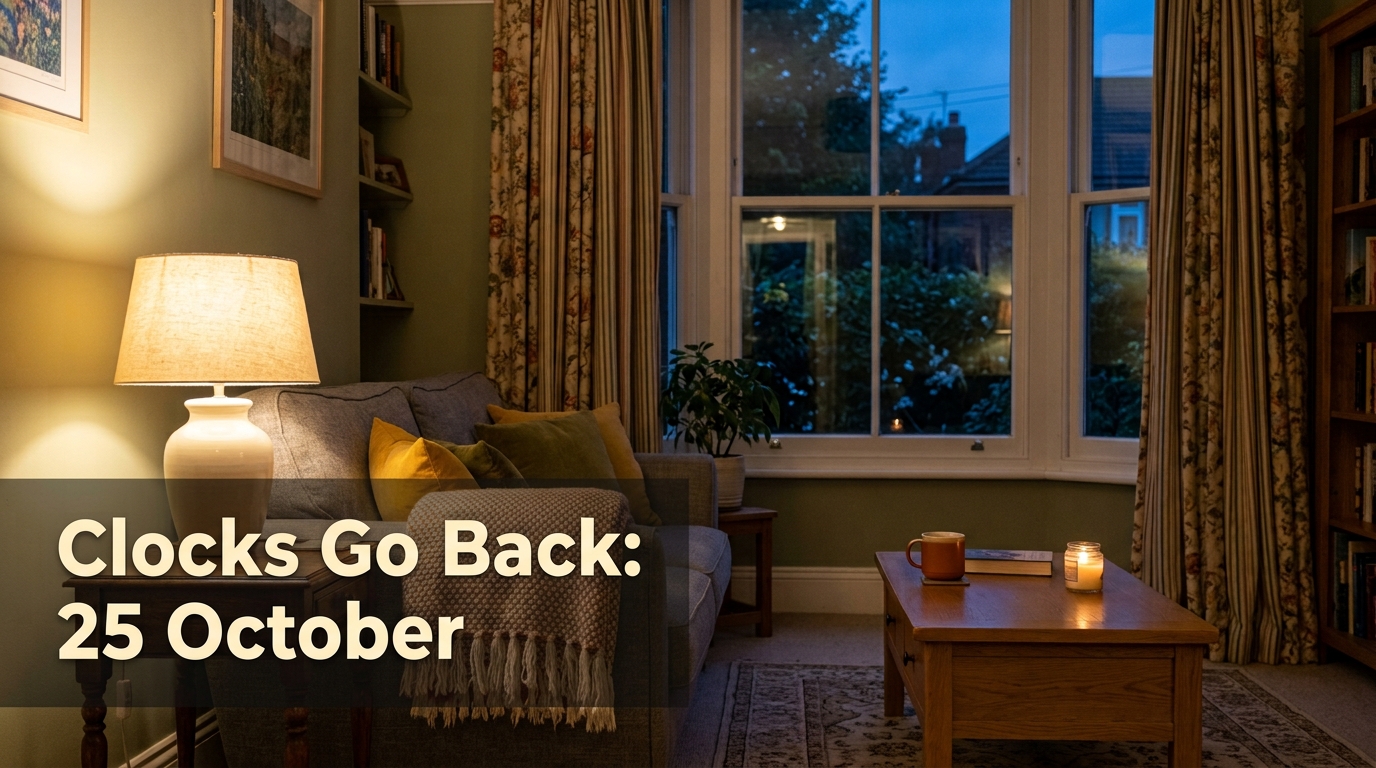
 The clocks go back on Sunday 25 October 2026, and while it means an extra hour in bed, it also marks the start of the darkest, coldest stretch of the UK's year. One Sunday you're leaving work in daylight the next, it's pitch black by five o'clock.
Most people notice the mood dip and the higher heating bills, but far fewer actually prepare for either. This guide covers exactly when the change happens, why it still exists, what it does to your body and your spending, and the practical, low-cost ways to get your home ready before the evenings close in.
When do the clocks go back in 2026?
The clocks go back one hour at 2am on Sunday 25 October 2026, moving the UK from British Summer Time (BST) back to Greenwich Mean Time (GMT). In practice, that means setting clocks back to 1am before you go to bed on the Saturday night, or simply letting your phone do it automatically.
The change always falls on the last Sunday in October, so it's the same weekend every year — only the exact date shifts slightly depending on the calendar.
Why do we still change the clocks?
The UK has moved its clocks twice a year since 1916, originally to make better use of daylight during wartime and save fuel. The system has been debated on and off ever since — there have been repeated calls in Parliament and from some retailers and road safety groups to scrap the twice-yearly change altogether, either by staying on GMT year-round or adopting permanent BST.
None of those proposals has been adopted, so for 2026 the clocks will change as normal. If that ever does change, it would be announced well in advance, so there's no need to plan around a different system this year.
What losing an hour of evening light actually does
Your mood and energy
The NHS recognises seasonal affective disorder (SAD) as a genuine type of depression that tends to appear in winter and ease off again in spring, and links it to reduced daylight affecting brain chemicals involved in mood and sleep. Not everyone who feels a bit flatter after the clocks change has SAD, but the pattern is common enough that the NHS lists specific things that help: getting outside in natural daylight when you can (even a short walk at lunchtime makes a difference), keeping to a regular sleep schedule, staying physically active, keeping up with friends and family, and cutting back on alcohol and late-night screen time.
Light therapy using a SAD lamp is also recommended by the NHS for some people — look for one producing around 10,000 lux with UKCA or CE marking, and use it as directed rather than for hours on end. If low mood is affecting your day-to-day life, it's worth speaking to a GP rather than relying on lifestyle changes alone.
Your spending habits
There's a simple, practical knock-on effect too: when it's dark by five and cold outside, most of us spend more evenings at home, on our phones, browsing. That's not a bad thing in itself, but it's exactly the environment where casual online shopping creeps up — an extra parcel here, a "just add this to get free delivery" upsell there. Going into the darker months with a rough sense of what you actually need (rather than shopping as something to do) is one of the simplest ways to stop autumn browsing turning into an expensive habit.
Getting your home ready before GMT arrives
A few small, inexpensive changes make the switch to darker evenings far less grim, and most of them are worth doing before the clocks actually change rather than after.
Lighting. A single overhead bulb makes a room feel colder and starker once it's dark by teatime. A cheap floor or table lamp with a warm-toned bulb, positioned where you actually sit in the evening, makes a noticeably bigger difference than upgrading the main light. John Lewis carries a wide range of table and floor lamps alongside warm-white LED bulbs if you're starting from scratch.
Draught-proofing. Letter boxes, gaps under external doors and old window seals let out more heat than most people realise, and cost very little to fix — a draught excluder or a roll of foam draught strip pays for itself within weeks once the heating's on daily.
Cosy basics. Thicker curtains, a spare throw for the sofa and a few extra cushions all make a living room feel warmer without touching the thermostat. Browse PrimeVoucher's Home & Garden deals for current offers on exactly this kind of thing before you buy at full price elsewhere.
One easy reminder. Clock-change weekend is also the traditional prompt to test smoke and carbon monoxide alarms and change the batteries if they take them — it costs nothing and takes two minutes.
It's also the point in the year when evening journeys get riskier
It's easy to forget just how much the clock change affects your commute or school run until the first Monday it happens. RoSPA (the Royal Society for the Prevention of Accidents) has repeatedly called for an end to the October clock change on road safety grounds, pointing to Department for Transport casualty data showing pedestrian deaths rising through October, November and December compared with September, with afternoon casualty rates peaking around 3pm–7pm — exactly when children are walking home from school and commuters are on their way back, but now doing it in the dark for the first time that year. A few habits are worth picking up before the change rather than after: check your bike lights and car headlights now rather than on the first dark evening you need them, wear something reflective if you're walking or cycling at dusk, and build a few extra minutes into the evening commute while everyone readjusts to driving and crossing roads in reduced light.
Don't let the darker evenings push your energy bill up too
The timing is unhelpful: the clocks go back just as Ofgem's autumn price cap rise lands, with the typical dual-fuel household's annual bill increasing by £60 (4%) from 1 October 2026. More hours of darkness means more hours with the lights and heating on, right when energy is already getting more expensive. Our guide to saving money as the energy price cap rises covers this in full, but a few quick wins specifically for the darker-evenings period are worth calling out here:
- Swap remaining old bulbs for LEDs in the rooms you use most in the evening — they use a fraction of the electricity and last far longer.
- Use a plug-in timer or smart plug for lamps and fairy lights so they're not accidentally left on all evening.
- Bring your heating schedule forward by 20–30 minutes rather than turning the thermostat up higher — it's usually cheaper to heat a room slightly earlier than to blast it hotter later.
- If you're buying lamps, an SAD lamp or heated throws this season, check for a working code first — our guide to stacking discount codes and cashback explains how to combine the two for extra savings on top of any sale price.
Five simple ways to beat the post-clock-change slump
- Get outside before lunch, not after. Morning daylight has the strongest effect on resetting your body clock, so a walk before or around lunchtime is more useful than one after work once it's already dark.
- Keep your sleep schedule consistent, even at weekends — going to bed and waking up at wildly different times makes the adjustment harder.
- Move your workout earlier if you can. If evening light was part of your motivation to exercise, an early-morning or lunchtime slot fills that gap once it's dark by 5pm.
- Plan something social each week through the darker months rather than letting evenings default to staying in — it's an easy thing to let slide once it's cold and dark out.
- Consider a light box if mornings feel especially hard. As above, the NHS-recommended specification is around 10,000 lux with UKCA/CE marking, used for a set period each morning rather than left on all day.
FAQs
When do the clocks go back in 2026? The clocks go back one hour at 2am on Sunday 25 October 2026, moving the UK from British Summer Time to Greenwich Mean Time.
Do the clocks go back or forward in October? Back. The clocks go forward (lose an hour) in spring and back (gain an hour) in autumn — "spring forward, fall back" is the easiest way to remember it.
Will the UK ever scrap the clock change? Not for 2026. There have been ongoing proposals to end the twice-yearly change, but none has been adopted, so the clocks will change as normal this year. Any future change would be announced well ahead of time.
What is a SAD lamp and do I actually need one? A SAD lamp is a light box that mimics natural daylight, typically used for a set period each morning. The NHS lists light therapy as one option for seasonal affective disorder, alongside daylight exposure, exercise and a consistent sleep routine — it's not something everyone needs, but it can help if mornings feel particularly difficult once the clocks change.
How can I keep my lighting costs down through winter? Switch remaining halogen or older bulbs to LEDs, use lamps rather than main overhead lighting where you can, and put evening lighting on a timer or smart plug so nothing's left running longer than it needs to be.
Before the evenings draw in
The clocks changing is one of the few dates in the UK calendar you can actually plan around — you know exactly when it's coming and roughly what it means for your evenings, your mood and your bills. Sort the lamp, the draught excluder and the smoke alarm batteries this week, and 25 October becomes a lot less bleak.
For more ways to cut costs as the temperature drops, browse PrimeVoucher's full list of UK stores for current voucher codes across home, energy-saving essentials and everyday shopping.